
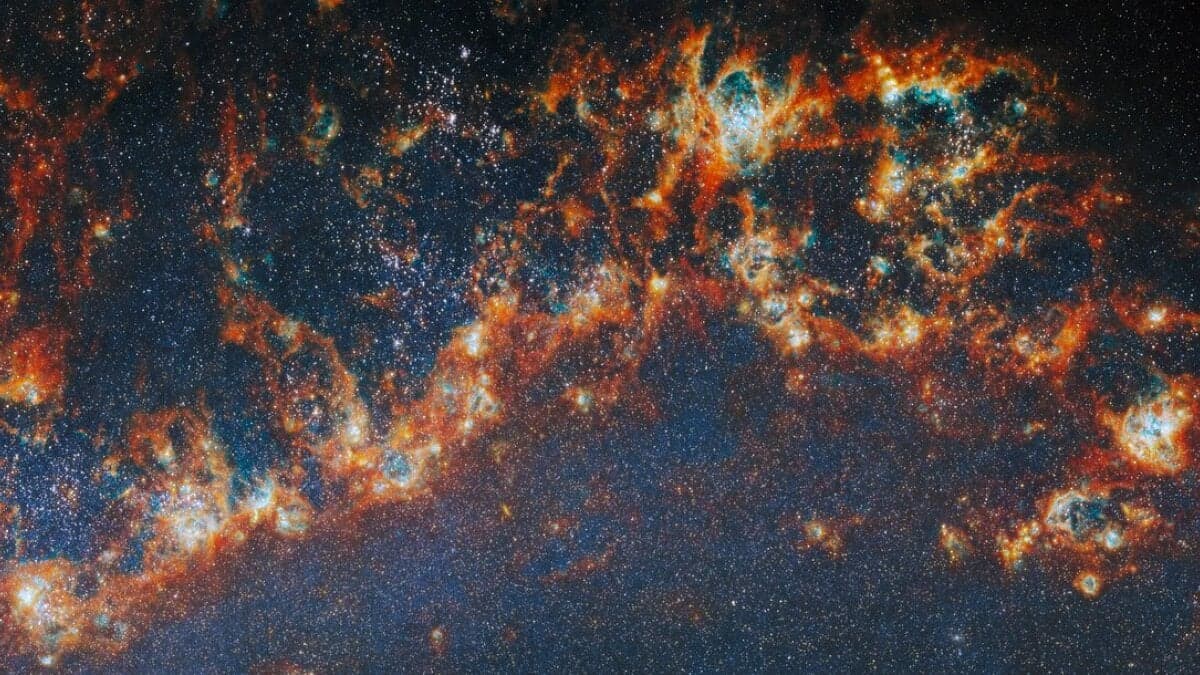
Introduction to Newborn Star Clusters
Newborn star clusters have long been a subject of fascination for astronomers, offering a unique glimpse into the early stages of stellar evolution and galaxy formation. These clusters, comprising thousands of young stars, are formed when giant molecular clouds collapse under their own gravity, triggering a burst of star formation. Recently, a team of scientists using NASA's James Webb and Hubble space telescopes has made a remarkable discovery, uncovering a curious pattern in the formation and evolution of these newborn star clusters.
The Study's Findings
The study, which analyzed thousands of newborn star clusters, revealed that the largest clusters are the fastest to lose their birth clouds. This phenomenon, known as 'cloud shedding,' occurs when the intense radiation and strong winds emanating from the young stars dispel the surrounding gas and dust, leaving the cluster exposed. The researchers found that the bigger the cluster, the faster it loses its birth cloud, with the most massive clusters shedding their clouds in a matter of just a few million years.
Understanding Cloud Shedding
Cloud shedding is a critical process in the evolution of newborn star clusters, as it determines the cluster's fate and the properties of the stars within it. When a cluster loses its birth cloud, it becomes vulnerable to the harsh conditions of the surrounding interstellar medium, which can disrupt the cluster's structure and even lead to its dissolution. The study's findings suggest that the largest clusters, which are often the most densely populated, are more efficient at shedding their clouds due to the collective effect of the intense radiation and strong winds from the numerous young stars.
Implications for Stellar Evolution
The discovery of this pattern in newborn star clusters has significant implications for our understanding of stellar evolution and galaxy formation. The study's findings suggest that the largest clusters, which are often the most massive, play a crucial role in shaping the surrounding interstellar medium and influencing the formation of subsequent generations of stars. Furthermore, the efficient cloud shedding in these clusters may be responsible for the formation of 'runaway' stars, which are high-velocity stars that have been ejected from their parent cluster and are now traveling through the galaxy.
The Role of NASA's James Webb and Hubble Space Telescopes
NASA's James Webb and Hubble space telescopes have been instrumental in the discovery of this pattern in newborn star clusters. The James Webb Space Telescope, with its unparalleled infrared sensitivity, has allowed scientists to peer through the dusty birth clouds and observe the young stars within, while the Hubble Space Telescope has provided high-resolution images of the clusters and their surroundings. The combination of these two telescopes has enabled researchers to study the clusters in unprecedented detail, revealing the complex interplay between the young stars, the surrounding gas and dust, and the interstellar medium.
Future Research Directions
The study's findings have opened up new avenues for research into the formation and evolution of newborn star clusters. Future studies will focus on exploring the properties of the stars within these clusters, including their masses, ages, and chemical compositions. Additionally, researchers will investigate the role of cloud shedding in shaping the surrounding interstellar medium and influencing the formation of subsequent generations of stars. The discovery of this pattern in newborn star clusters has also raised questions about the universality of this phenomenon, with scientists eager to explore whether similar patterns exist in other galaxies and at different stages of cosmic evolution.
Conclusion
In conclusion, the discovery of this curious pattern in newborn star clusters has shed new light on the formation and evolution of these fascinating objects. The study's findings, made possible by the combined power of NASA's James Webb and Hubble space telescopes, have significant implications for our understanding of stellar evolution and galaxy formation. As researchers continue to explore the properties of these clusters and their role in shaping the universe, we can expect to uncover even more secrets about the mysteries of the cosmos. The study's results have also highlighted the importance of continued investment in astronomical research and the development of new telescopes and observational facilities, which will enable scientists to push the boundaries of human knowledge and explore the universe in unprecedented detail.
- The study's findings have significant implications for our understanding of stellar evolution and galaxy formation.
- The largest newborn star clusters are the fastest to lose their birth clouds.
- Cloud shedding is a critical process in the evolution of newborn star clusters.
- NASA's James Webb and Hubble space telescopes have been instrumental in the discovery of this pattern.
- Future research will focus on exploring the properties of the stars within these clusters and the role of cloud shedding in shaping the surrounding interstellar medium.